












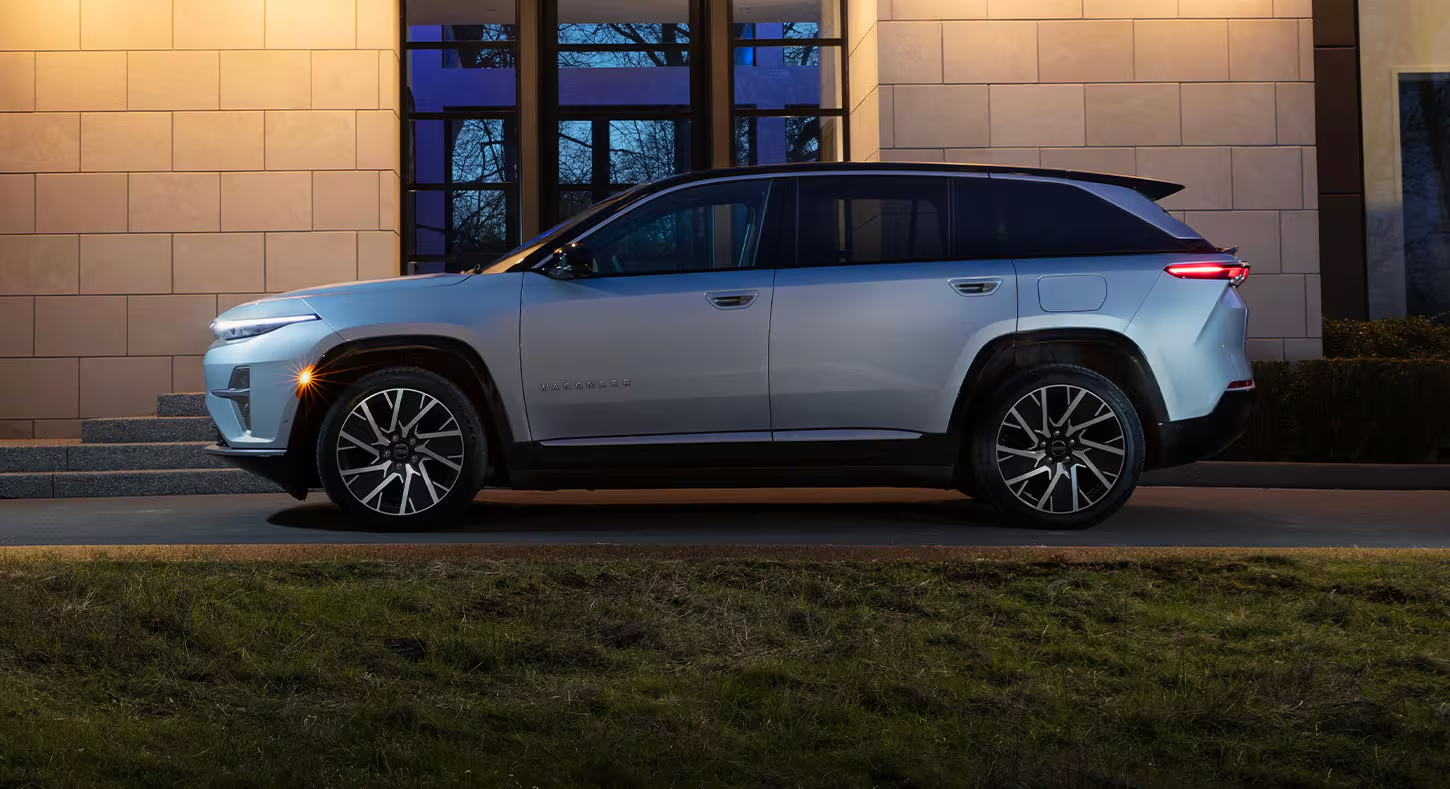
The Jeep Wagoneer S Limited symbolizes a notable shift for the Jeep brand. This model is not just another addition; it’s Jeep’s first fully electric SUV aimed at the U.S. market. Designed from scratch, it aims to guide one of the most recognized brands in America into a battery-powered future. With standout features on paper like 500 horsepower (373 kW), all-wheel drive, an estimated range of 294 miles, and a tested price tag of $67,195, it certainly sounds promising.
However, the critics have raised eyebrows regarding its construction quality, claiming it feels cheap and is poorly assembled. To uncover the truth behind these assertions, we had the Wagoneer S Limited for a comprehensive week-long test drive.
Our experience involved road trips, navigating bustling urban landscapes, and plugging it into four different public charging stations. A summary of our findings follows.
Quick Facts
After a full week of driving, one persistent question arose: what connects this vehicle to Jeep? Nothing about the Wagoneer S, from its ride to its interior and styling, seems to resonate with Jeep’s classic identity.
This SUV lacks ruggedness, the typical outdoorsy essence, and the spirit that usually inspires Jeep models. Instead, it shines with a polished, quiet, and surprisingly fast demeanor, reminiscent of Chrysler vehicles. This raises an intriguing question about missed potential for the Wagoneer S—one that combines both form and function. Read further to explore why this connection matters.
The Basics Outside and Under The Skin
The Wagoneer S utilizes Stellantis’ STLA Large platform, firmly placing it in the two-row midsize SUV category. Its power is generated by dual electric motors that deliver impressive specifications: 500 hp (373 kW) and 524 lb-ft (710 Nm) of torque.
Jeep does provide an over-the-air software upgrade that boosts performance, bringing it closer to the top-tier versions’ specs. The brand claims a 0–60 mph (97 km/h) time of approximately 3.4 seconds; however, our test vehicle was not enabled for this extra power. Real-world performance varies significantly based on the battery’s state of charge.
As we examine the SUV’s exterior design, it does not exude an aura of power or ruggedness typical of Jeep. While it features a Jeep-style grille, the overall presentation feels more akin to Chrysler, showcasing sleek and modern aesthetics.
The dual-tone color scheme enhances this impression, especially with its understated profile. The rear spoiler is also an unusual touch, raising questions about Jeep’s design identity. How many Jeeps traditionally come factory-equipped with such a feature?
Interior Quality
The seating in both front and rear compartments is very comfortable, offering excellent backing and cushioning. Although they appear somewhat basic for a vehicle nearing $70,000, they function well for long trips without causing discomfort.
Front passengers might find a minor issue with headroom — particularly if you’re on the taller side — but it’s generally adequate for most. Rear-seat occupants enjoy ample legroom, and overall cabin space feels well-utilized.
Nevertheless, for this price point, expectations are higher. Basic features such as seat ventilation should be standard, and further options like power adjustments would justify the cost. Competing brands, like Hyundai, offer these luxuries at lower price tags.
The dashboard and center console are designed for straightforward use, and Stellantis’ latest infotainment system mostly delivers a responsive experience. Yet, there’s a noticeable flaw: a large piano-black panel on the passenger side that not only looks cheap but also attracts dust and fingerprints, effectively serving as a reminder of cost-cutting measures rather than designer intent.
Climate control functions can also feel hit-or-miss. The heated seat and steering wheel options are always on display but may lag or become unresponsive, particularly in colder weather. This experience is frustrating, as physical buttons would immediately resolve these issues.
Jeep does offer a feature that allows for automatic climate control adjustments based on external temperatures. While useful, it can often become a hassle to deactivate heated seats when they’re too warm.
Below the control interface, there’s a haptic feedback panel that streamlines adjustments but still lacks the satisfaction that comes with traditional buttons. The digital gauge cluster is a highlight, standing out for its readability and intuitive design.
Regarding construction quality, we specifically looked for the poorly assembled rumors during our test. Although some elements exuded quality, the overall feel leaned more towards ‘standard’ than ‘premium.’ When compared to similarly priced vehicles, especially from brands like Hyundai, the Wagoneer S may struggle to impress.
This interior is not flawed, yet it lacks a sense of commitment to excellence, particularly considering it’s Jeep’s first electric model in the American market. It is more functional than it is exceptional.
In terms of storage, the front trunk proves helpful for smaller items, while the cargo space expands nicely with rear seat folding.
Drive Impressions
When it comes to driving experience, the Wagoneer S truly shines, although its identity crisis becomes increasingly apparent.
This SUV doesn’t behave like a traditional Jeep. If anything, its performance can be likened to that of the Grand Cherokee Trackhawk—not for the sound but for its smooth, quick handling on paved roads. The Wagoneer S impresses with its rapid acceleration, although battery state affects performance significantly.
Although we clocked a 0–60 mph run at 4.85 seconds at low battery levels, it never felt sluggish, offering an engaging driving experience.
Steering responsiveness is another strong point. It’s precise and inspires confidence, allowing for quick turns with minimal body roll. This is an EV that actively encourages spirited driving rather than merely accepting it.
On the downside, brake performance raises concerns. While the SUV feels heavy, the braking system seems inadequate compared to similarly powered rivals. Although we didn’t experience any critical braking situations, the pedal feel left much to be desired.
Moreover, the suspension tuning presents a puzzling situation. It handles smoothly over normal roads but struggles when encountering rough terrain or potholes, producing jarring impacts felt inside the cabin.
Given the Wagoneer S isn’t designed for off-road adventures and comes fitted with all-season tires, it might benefit from a stronger suspension that aligns better with the Jeep identity.
Competition
The Wagoneer S enters a highly competitive market. Starting around $65,200, it contends with models such as the Tesla Model Y Performance, Chevrolet Blazer EV SS, and Ford Mustang Mach-E GT, all of which offer comparable or superior performance and interior quality for similar or lower prices.
Then factor in specific requirements. For a speedy EV, consider the Hyundai Ioniq 5 N. For spacious comfort, Cadillac presents options like the Lyriq. The choices expand dramatically in this price range, even including luxury brands like the Porsche Macan EV for just marginally more than a fully-loaded Wagoneer S.
This is where further emphasis on off-road capabilities could significantly enhance the Wagoneer S appeal.
Final Thoughts
The Jeep Wagoneer S Limited presents as an attractive, performance-oriented SUV that’s generally enjoyable to drive. Yet, its detachment from the Jeep brand identity stands out as its primary flaw.
This model had the potential to embody a modern halo vehicle for Chrysler—not an extreme sports car but rather something sophisticated and aspirational.
With the right positioning geared toward an older demographic, enhanced seating options, and better color choices, it could regain relevance. Instead, it risks overshadowing its identity within Jeep’s broader lineup. Though the Wagoneer S is commendable, it feels tailored for pavement enthusiasts rather than true Jeep lovers.