







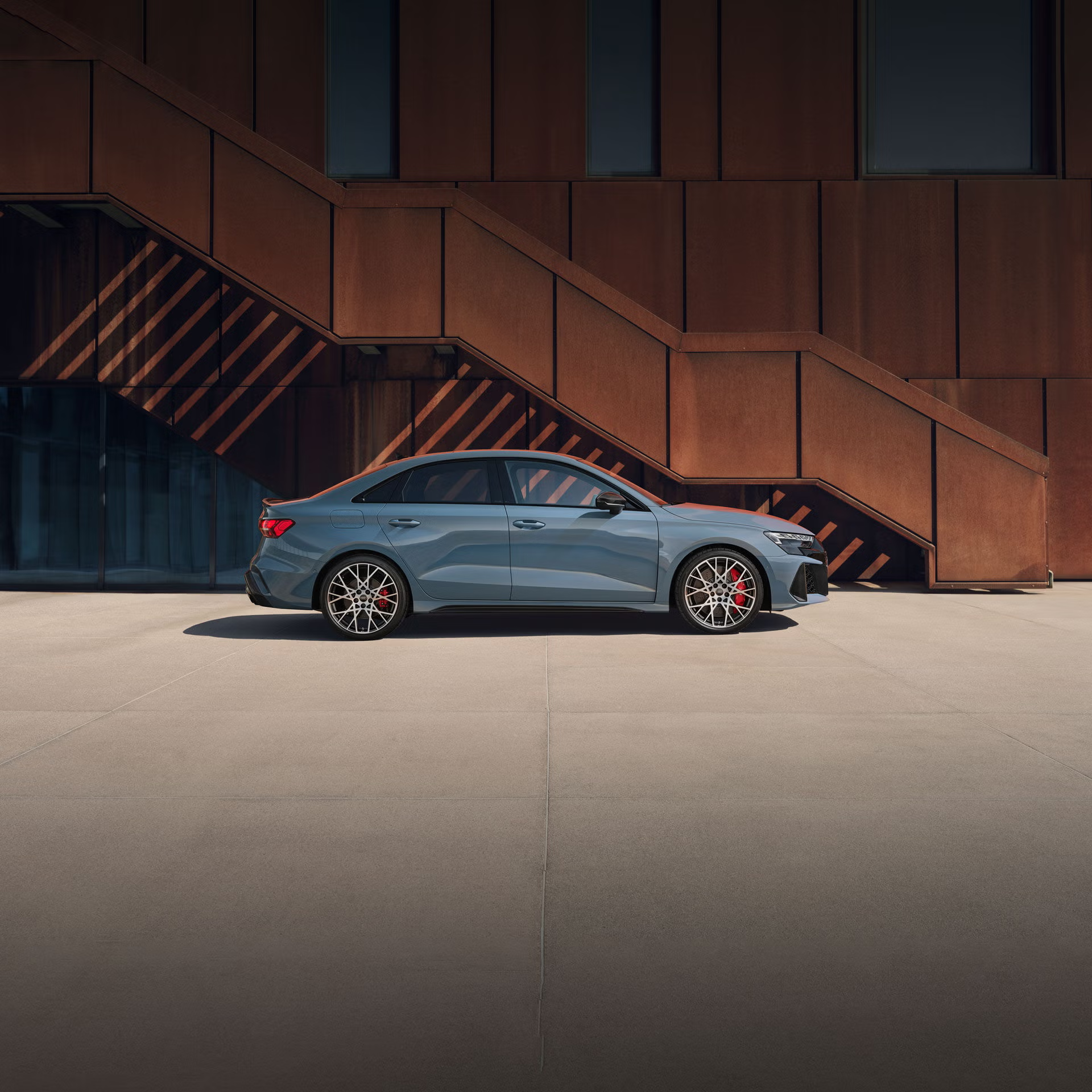
High-performance compact cars have carved out a unique niche in the automotive world, and after spending a week with the Audi RS3 Sedan, it’s clear that this vehicle is a potent contender. If you’re desiring a thrilling driving experience that transcends the typical offerings of modern turbocharged hatchbacks and sedans, the RS3 stands as a compelling option, feeling like it’s in a class of its own.
With substantial updates for 2026, the RS3 seems to be edging closer than ever to fulfilling the dreams of driving enthusiasts.
Notable Evolution of the RS3
Originally launched in 2022, the current generation of the RS3 underwent significant enhancements by late 2024. Maintaining its core engine and all-wheel drive system, Audi has focused on refining the design, improving interior elements, and enhancing performance capabilities. What sets this updated RS3 apart from the competition?
Key Facts About the RS3
The introduction of the Audi RS3 has made it the only compact performance car available with a five-cylinder engine. While competitors have opted for higher-revving three- or four-cylinder turbo engines, Audi continues to champion its iconic 2.5-liter five-cylinder powerhouse. This unique feature not only defines the RS3 but also amplifies its allure among driving enthusiasts.
For 2026, performance figures remain unchanged with 294 kW (394 hp) and 500 Nm (369 lb-ft) in Australian specifications—equivalent to the US version. While the Mercedes-AMG A 45 S boasts a more powerful 310 kW (421 hp) 2.0-liter turbo engine, the RS3’s performance more than satisfies enthusiasts looking for excitement behind the wheel.
What the Facelift Offers
This latest RS3 has received valuable updates to its torque splitter and variable torque distribution system, allowing it to react more effectively to different driving conditions. Audi’s refinements to brake torque vectoring enhance responsiveness during cornering, leading to a notable decrease in understeer. In fact, understeer has virtually been eliminated, giving way to a more playful driving experience characterized by oversteer.
The real-world performance benefits are notable—during testing at the iconic Nurburgring, the 2025 RS3 managed a remarkable lap time of 7:33.123, surpassing the previous model by over five seconds.
Updated Design Features
Audi has made several eye-catching design updates to the RS3. A new, broader hexagonal Singleframe black grille dominates the front, while the revised air intakes enhance the aggressive aesthetic. Although the RS3 badge has been removed from the grille—a surprising omission—rear design enhancements include fresh taillight graphics, an expanded diffuser, and oval exhaust outlets.
Pricing in Australia starts at AU$104,800 ($70,300) for the hatchback, while the Sedan begins at AU$107,800 ($72,300) before on-road costs. Although this positioning makes it more affordable than the A45 S, scrutiny of interior materials may lead some to question the overall value proposition.
Interior Design: A Mixed Bag
Inside the RS3, there are both standout features and missed opportunities. Our Kyalami Green test car featured the AU$2,150 ($1,400) RS styling package, adding striking Alcantara elements and vibrant accents throughout the cabin. The 2026 revamp includes a modern flat-top, flat-bottom steering wheel featuring two prominent red RS buttons that allow quick access to either RS Individual or RS Performance driving modes. While the wheel feels fantastic, the new haptic buttons don’t offer the same tactile satisfaction as their mechanical predecessors.
The sport seats provide excellent support, though some drivers may wish for additional bolstering for track days. In Europe, carbon fiber-backed bucket seats are an available option, although they’re notably absent in the Australian market.
The standard features are impressive, with a 12.3-inch digital instrument cluster, a 10-inch infotainment system, a head-up display, and a premium 15-speaker audio system. However, elements such as hard black plastic on the dash and door panels detract from an otherwise high-end feel, while rear seat space remains cramped.
A Performance Powerhouse
Once behind the wheel, any reservations about the interior swiftly diminish. Driving the RS3 is an exhilarating experience, powered by its robust five-cylinder engine and quattro all-wheel drive system. Audi claims that the 2025 RS3 Sedan can accelerate to 100 km/h (62 mph) in just 3.8 seconds, and we recorded an impressive 3.78 seconds using GPS. This level of performance once belonged only to supercars like the iconic Lamborghini Gallardo LP560-4.
The RS3 grips the road effortlessly, even under less-than-ideal conditions, thanks to its Bridgestone Potenza Sport tires. Coupled with a responsive seven-speed dual-clutch transmission, gear changes feel polished, although there are moments when the gearbox exhibits clumsiness at lower speeds.
Driving Modes and Soundtrack
The RS3 offers seven distinct driving modes, though I spent the majority of my time in RS Individual. In this mode, the engine and exhaust sound compellingly aggressive, producing a thrilling auditory experience that outclasses any four-cylinder competitor. Opening the windows amplifies the rich soundtrack, making music playlists seem superfluous during spirited drives.
Innovative All-Wheel Drive Technology
The introduction of a torque splitter has dramatically improved handling, allowing the RS3 to send up to 100% of available rear torque to a single wheel. This innovation effectively eliminates understeer and offers a range of handling characteristics based on the selected driving mode. The response during sharp turns is instantaneous, with accurately tuned steering and excellent tire grip.
For the more adventurous driver, the RS Torque Rear mode enables rear-biased handling, making it possible to initiate controlled slides. This setting, made for more daring maneuvers, allows for exciting driving experiences—though it can become tricky in a straight line.
Built for Versatility
The standard brakes are remarkably effective, with Audi offering carbon ceramic options for those who frequent racetracks. Yet, the standard adaptive suspension is comfortable, whether cruising on highways or zipping around city streets. Moreover, the RS3 is equipped with advanced technologies like adaptive cruise control and lane-keeping assistance, enhancing its practicality for everyday use.
In terms of fuel efficiency, I managed to achieve 12.1 l/100 km (19.4 US mpg) during my week-long test, surpassing the official figure of 13.1 l/100 km (17.9 US mpg) despite a blend of driving conditions.
Conclusion
While the RS3 exhibits a few interior shortcomings and limited rear space, it excels as a remarkable high-performance vehicle. It can easily match and outperform rivals on winding roads, and I can only imagine the thrill of taking it to a racetrack. With a compelling engine at its core and a price point below the Mercedes-AMG A45 S, the Audi RS3 emerges as a clear choice for anyone pursuing the pinnacle of compact performance.