


















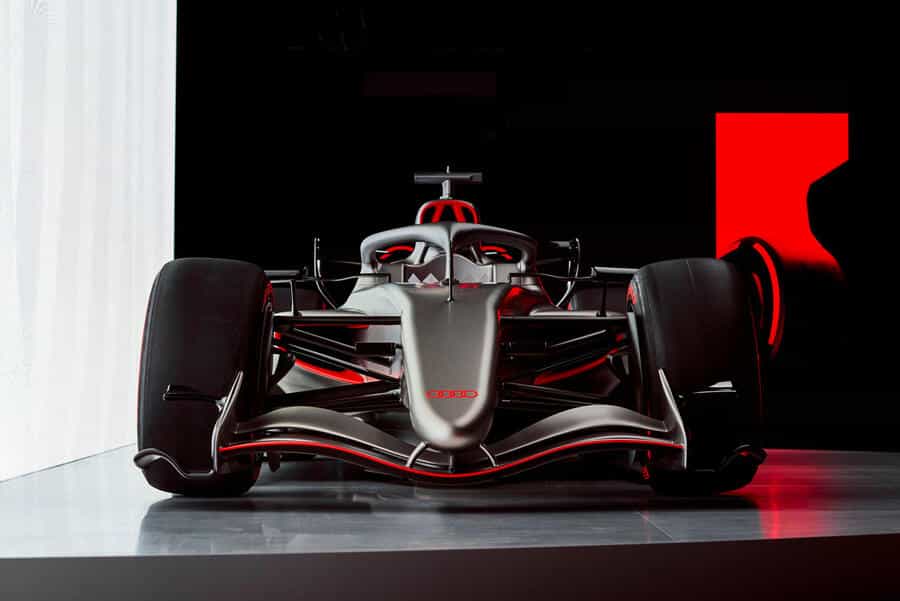
We are just over 115 days away from Audi entering Formula 1, marking its first appearance in this high-octane sport in 87 years. The countdown hangs on visible walls, screens, and lips throughout Audi’s new F1 base in southern Germany. However, as this massive transition draws near, Audi faces many significant uncertainties.
Audi’s choice to dive into the swift realm of F1 coincides with a comprehensive overhaul of the sport’s regulations. In addition, the decision to establish a wholly independent team adds another layer of complexity. While Audi has acquired the previously lower-performing Sauber team to construct its chassis, the entirety of the new setup is being developed from the ground up.
The ambitious goal? To contend for a championship within four years.
A crucial aspect of their strategy includes the development of a proprietary power unit. Audi seems less inclined to become a mere supplier for established teams like Mercedes-AMG, Honda, or Ferrari. Chief Operations Officer Christian Foyer acknowledges that this ambition positions the team “six years behind” its competitors, including newcomer Cadillac, which will rely initially on Ferrari engines. Despite this, Foyer remains optimistic, stating that there is “nothing to fear” as he guides us through the corridors of the F1 factory located in Neuburg an der Donau.
The facility itself is impressive yet discreet, resembling a tough building of blackened steel tucked away near an equally austere test track.
Upon entering, the scope of what lies within becomes apparent. Visitors must lock away their devices and agree to secrecy before being led through secured doors, instantly struck by an intense warmth. The sound of machines fills the air as the winter chill is dispelled by a wave of heat, revealing a facility dense with computers and testing machines.
Our first destination is the fuel lab, which will be pivotal to Audi’s success in the forthcoming seasons. With regulations shifting from E10 fuel to carbon-neutral alternatives such as biofuels, the lab’s role becomes vital. Quality Manager Klaus Spang explains that this transition allows for customization tailored to specific combustion processes, potentially enhancing performance while also introducing uncertainty regarding combustion behavior. The lab is lined with various flasks of differently colored fuels awaiting investigation.
Used oil will play a crucial role in identifying potential issues, as samples are subjected to a flame burning as hot as 10,000°C to examine their purity. However, Audi has yet to pilot a complete engine in testing, meaning uncertainties loom large as its inaugural F1 season approaches.
Compounding the challenges are strict regulations that limit testing: starting in 2026, teams can only conduct 700 hours of engine tests and 400 hours for electrical components. Full drivetrain testing could detract from this allocation.
Adding to the apprehension at Neuburg is the fact that Audi is only beginning to test its engine, having prioritized its hybrid system thus far. The urgency is palpable as the team lacks real-world data on how its new turbocharged V6 engine will perform.
In light of these uncertainties, Audi’s procurement strategy is characterized by caution. Despite each F1 driver being permitted only three engines for the 2026 season, the team plans to manufacture between 50 and 100 engines in total, reserving the choices for races while the remainder will be earmarked for ongoing tests and development.
Each engine development will involve two engineers, and as we pass through the workshop, a palpable sense of urgency fills the air as exhaust components and blocks are moved around. Despite the hustle, the direction of their efforts remains unclear.
Hidden deep within the facility lies what Foyer labels mission control. Entering this zone reveals a stark contrast to the factory’s industrial elements; the walls are black, illuminated by cinema-like spotlights. The atmosphere shifts immediately, as though one has stepped into a strategic nerve center.
A large screen plays a torrent of race data, camera feeds, and radio communications alongside an organized air of control.
This dual control room setup reflects Audi’s unique approach to F1. While Sauber has a similar facility in Hinwil, Switzerland, this parallel system in Neuburg spans two countries with 66 engineers working alongside an additional 58 on-site during each race, all contributing layers of expertise and data.
Team principal Jonathan Wheatley is said to “steer much of the process,” but this effort appears to be on a grander scale than during his time with Red Bull Racing.
Audi’s team recognizes the ambitious pathway ahead. Project Director Mattia Binotto, a former Scuderia Ferrari leader, conveys an acute awareness of the challenges associated with their 2030 championship goal. “We are aware of the difficulty,” he remarks. “If we stay grounded in our expectations, the pressure becomes manageable. However, we must acclimate to it as pressure is part of the landscape.”
Binotto is confident about the critical choices made, emphasizing that the decision for full control over both the chassis and power unit is essential for achieving competitive strength and technical advantage. Audi aims not only to compete but also to win, accepting the intricacies involved in this journey.
The atmosphere surrounding Audi’s entry into F1 is steeped in uncertainty regarding the team’s positioning next season, especially due to the fundamental regulatory changes. Binotto expresses the team’s unpredictability, noting that past performance metrics may no longer apply.
While there are tools at hand to gauge performance, reality may hold surprises once racing begins.
Wheatley is more optimistic about the team’s recent trajectory. He remarks on finding a younger team ready to innovate and grow beyond simply delivering two cars to the track on race day.
He provides an example from the Brazilian Grand Prix, where rookie Gabriel Bortoleto’s mishap required the team to rebuild a car in remarkable time. “This team wouldn’t have been able to manage that just a year ago. This shift is driven by spirit and a belief in itself.”
One thing is evident: Audi anticipates success. CEO Gernot Döllner emphasizes the company’s historical legacy in motorsport, stating, “Audi has never entered a racing series just to participate but to lead, innovate, and win. That’s precisely our aim in Formula 1.” The commitment to quality and determination to make an impact is succinctly captured in Döllner’s concluding thought: “When I took over as CEO two years ago, we decided to sharpen our focus in this arena because there are only two ways to approach it: with excellence or not at all.”